

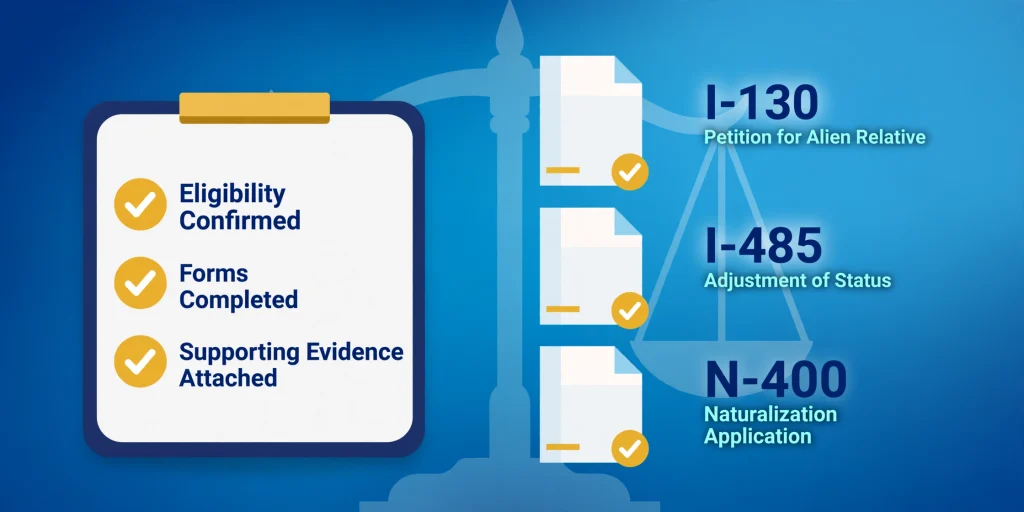
If you’re wondering what an immigration paralegal actually does — and which parts of your caseload you can safely hand off — this guide lays it out task by task. Below are 12 concrete immigration paralegal duties, grouped into four buckets, plus the bright lines: what stays with the attorney, and why immigration-specific training changes what a paralegal can handle from day one.
What does an immigration paralegal do day to day?
An immigration paralegal handles the administrative backbone of immigration casework: preparing USCIS forms, assembling evidence packets, tracking deadlines and priority dates, communicating with clients about documents and appointments, and keeping case files organized — all under an attorney’s supervision. They don’t give legal advice or appear in court; they make sure nothing administrative slows a case down.
A typical day moves between the inbox, the case management system, and the filing checklist. Morning might mean reviewing overnight USCIS receipt notices and updating case statuses; midday is form preparation and evidence assembly; afternoon is client follow-ups — chasing a missing birth certificate, confirming a biometrics appointment, answering “what happens next?” questions. The throughline is always the same: keeping every case’s paperwork complete, current, and on schedule so the attorney can focus on strategy and clients.
Which immigration tasks can a paralegal handle?
Immigration paralegals can handle 12 core task families spanning intake, USCIS form preparation, evidence assembly, and docket control — every administrative step of a case from the first questionnaire to the final status check. What they can’t do is give legal advice, set case strategy, or sign off on filings. Here is the full breakdown, grouped into four buckets.
Bucket 1: Intake & client communication
1. Intake questionnaires. Drafting, sending, and reviewing tailored intake questionnaires that capture the facts the attorney actually needs the first time — travel history, entries and exits, prior filings, family relationships. A well-built questionnaire cuts the back-and-forth that stalls cases in week one.
2. Document collection. Requesting, logging, and chasing the documents every case requires: passports, birth and marriage certificates, tax records, pay stubs, police clearances. The paralegal maintains a per-case checklist and follows up until the file is complete, so missing documents surface early instead of at filing.
3. Client status updates. Routine communication — confirming receipt of documents, explaining what happens next in plain language, and answering procedural questions. This keeps clients calm and informed without consuming attorney hours on non-legal updates.
4. Biometrics & appointment scheduling. Scheduling ASC biometrics appointments, preparing clients for what to bring, handling reschedule requests, and tracking interview notices. Missed appointments create months of delay; a paralegal makes sure they don’t get missed.
Bucket 2: Forms & filings
5. USCIS form preparation. Drafting the forms at the heart of immigration practice — I-130 petitions, I-485 adjustment applications, N-400 naturalization applications, I-765 work authorization requests, and others — by transferring verified intake data into each field accurately and consistently across related filings.
6. Edition-date & fee verification. Checking that every form is the current USCIS edition before filing (an outdated edition means automatic rejection) and calculating correct filing fees, including separate payments per form and fee-waiver requests on Form I-912 where eligible. This single verification step prevents some of the most common — and most avoidable — rejections.
Bucket 3: Evidence & case building
7. Supporting-evidence packets. Assembling complete evidence packages: organizing documents in the order adjudicators expect, tabbing and labeling exhibits, and cross-checking that every claim in the filing has supporting proof behind it. A clean packet is easier to adjudicate — and harder to deny on a technicality.
8. RFE response assembly. When USCIS issues a Request for Evidence, the paralegal pulls the requested documents, organizes the response package, drafts the cover letter and exhibit index for attorney review, and tracks the response deadline. Speed and completeness here directly affect outcomes.
9. Country-condition research support. Gathering background materials the attorney needs for asylum and relief cases — news reports, human-rights documentation, country-condition summaries — and organizing them into usable, cited research files. The paralegal does the legwork; the attorney decides how it fits the legal argument.
Bucket 4: Docket & deadline control
10. Priority-date tracking. Monitoring Visa Bulletin movement and each client’s priority date so the firm knows the moment a case becomes current — and no eligible client waits a month longer than necessary because nobody was watching the bulletin.
11. Receipt-number monitoring & case-status checks. Logging USCIS receipt numbers, running regular case-status checks, and flagging anything unusual: a case stuck beyond normal processing times, a notice that never arrived, a transfer to another service center. Early flags mean early action.
12. Hearing-date & deadline calendars. Maintaining the firm’s master calendar of EOIR hearing dates, USCIS deadlines, RFE response windows, and filing cutoffs — with advance reminders, not day-of surprises. In immigration practice, a missed deadline can end a case; this is the task that makes sure that never happens.
Can a paralegal file USCIS forms?
A paralegal can prepare, assemble, and organize a USCIS filing, but the filing itself goes out under the attorney’s authority. In practice this means the paralegal drafts the forms, compiles the evidence, verifies edition dates and fees, and prepares the complete package — then the attorney reviews everything, signs where a signature is required, and takes responsibility for the submission. Whether the package is mailed or e-filed, the attorney of record is the one on the filing.
This division is a feature, not a limitation. The attorney’s review is the quality gate, and the paralegal’s preparation is what makes that review fast — the attorney checks a complete, organized package instead of building one from scratch. Firms that get this workflow right find that attorney review time per filing drops sharply while accuracy goes up.
What should attorneys never delegate?
Legal advice, case strategy, and anything requiring the attorney’s professional judgment stay with the attorney — always. The bright lines are clear: a paralegal must not tell a client whether they qualify for a benefit, which strategy to pursue, or what the legal risks of an action are. They must not sign filings, certify documents, or represent the client before USCIS, EOIR, or any court.
Think of it this way: the paralegal owns the how and the when — how the forms get completed, when the deadlines hit, how the evidence is organized. The attorney owns the what and the why — what relief to seek, why a particular argument works, and whether the filing is legally sound. Every task in the 12 above sits on the paralegal’s side of that line, performed under attorney supervision. When a client question crosses into legal territory, the trained paralegal’s job is to recognize it and route it to the attorney — not to answer it.
Why does immigration-specific training matter for these tasks?
Immigration tasks look simple on paper and punish inexperience in practice. Form edition dates change without fanfare. RFE patterns shift by service center. The Visa Bulletin has its own logic. USCIS filing fees, lockbox addresses, and biometrics procedures all have details that a generalist learns only by making mistakes — and in immigration work, mistakes cost clients months or their status.
A paralegal trained specifically on immigration workflows arrives knowing which I-485 edition is current, what a complete evidence packet looks like, how to read a priority date, and what “case remains pending” actually signals. That training compresses a 2–4 month ramp-up into productive work from week one. It also changes the supervision burden: instead of teaching basic workflows, the attorney reviews finished work — which is the entire point of delegation. (SMY Solutions paralegals are AILA-trained — trained through American Immigration Lawyers Association programs and resources.)
Frequently asked questions
Can an immigration paralegal give legal advice?
No. Giving legal advice — telling a client whether they qualify for a benefit, recommending a strategy, or assessing legal risk — is the practice of law and belongs to the licensed attorney. A trained immigration paralegal knows where that line is and routes legal questions to the attorney rather than answering them.
Can an immigration paralegal sign USCIS forms?
No. Signatures on USCIS filings, certifications, and anything filed with EOIR must come from the attorney of record (or the client where appropriate). The paralegal prepares the complete package; the attorney reviews and signs.
What’s the difference between an immigration paralegal and a general paralegal?
Training and familiarity. A general paralegal can learn immigration work, but needs months to absorb form types, edition-date discipline, filing cadence, RFE patterns, and USCIS procedures. An immigration-trained paralegal starts with that knowledge, which eliminates the training cycle that otherwise falls on the attorney.
Can a paralegal communicate directly with clients?
Yes — for administrative matters. Scheduling, document requests, status updates, and procedural explanations are all appropriate paralegal communication, and clients often prefer the faster response. Anything touching legal advice or strategy goes to the attorney.
How do I know if my firm needs immigration paralegal support?
Three signals: the attorney is spending hours each week on forms, intake, or deadline tracking instead of legal work; deadlines or documents have slipped because no one owned the docket; or every new hire restarts the same immigration training cycle from zero. If any of those sound familiar, the administrative load has outgrown the current staffing.
The bottom line: an immigration paralegal takes on the full administrative lifecycle of a case — intake, forms, evidence, and deadlines — so attorneys spend their time on judgment, strategy, and clients. The key is matching the delegation to the training: a paralegal who already knows immigration workflows delivers value from the first file.
If your firm is losing attorney hours to the 12 tasks above, take a look at our Paralegal Assistants service page to see how trained immigration paralegal support works in practice — and read Immigration-Trained Paralegals: What Specialized Training Covers for a breakdown of what that training actually includes.