
When Should Your Firm Hire a Virtual Immigration Paralegal? 7 Signs You’re Ready
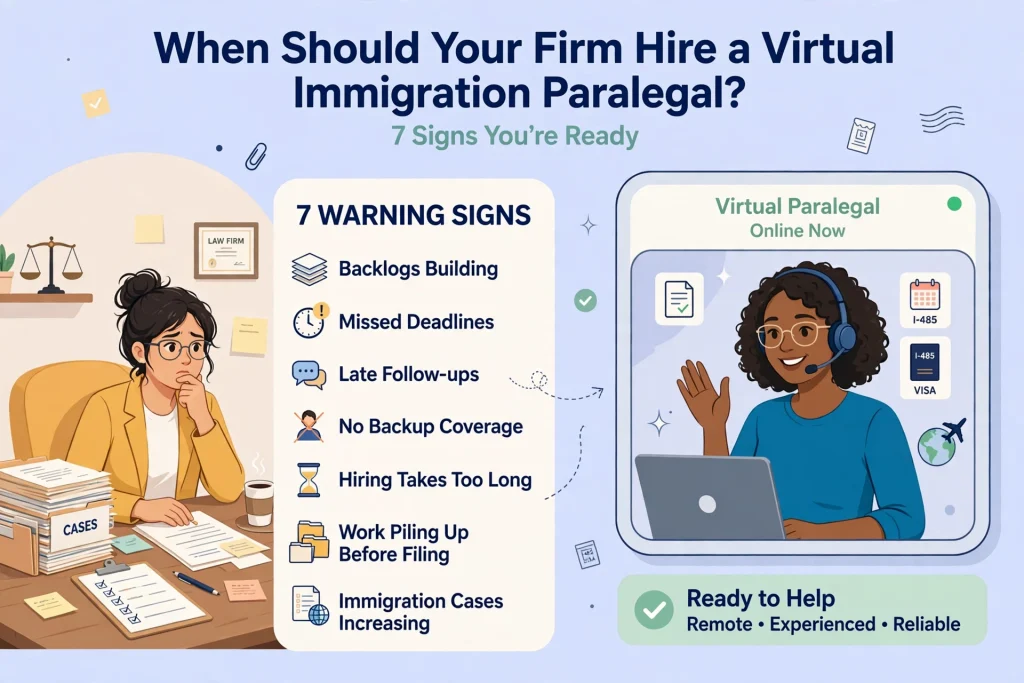
Your firm is ready to hire a virtual immigration paralegal when attorneys regularly do admin work instead of legal work, deadlines or documents have slipped, or every new hire restarts the same immigration training cycle. If two or more of the seven signs below sound familiar, the administrative load has outgrown your current staffing.
The job behind the question
When you run an immigration firm and admin keeps eating attorney time, you want to recognise the signs that staffing has outgrown the load, so you can delegate the bottleneck first instead of hiring blind or waiting for a missed deadline. That is the job this guide serves. It does not try to sell every firm the same hire. A solo attorney with one stalled intake file and a growing firm with deadlines in one person’s memory have different problems, even if both feel busy. The seven signs below separate those problems, so the fix matches the cause.
A useful way to read them is to mark each sign as true, partly true, or not true for your firm right now, not in general and not last year. Two or more signs sounding familiar, in the original draft’s test, means the load has outgrown current staffing. The test works only if the marking is honest. A sign that is true once a quarter is not the same as a sign that is true every week. Look for the pattern, not the exception.
Sign 1: Attorneys spend hours on forms, intake, or tracking
The scene is familiar to most immigration attorneys. The attorney sits down to draft I-130, I-485, or N-400 forms, then chases the documents that go with them, then tracks receipt numbers to confirm what arrived and what did not. Hours pass. The work is careful and necessary, and it is not legal judgment. It is form work, document work, and tracking work, and a trained paralegal can own it.
The solver’s question is not whether attorneys can do this work. They can, and many do it well. The question is what those hours cost when they are spent here instead of on strategy, clients, and decisions only an attorney can make. Strategy and clients should fill attorney hours, not paperwork. When paperwork fills them week after week, the firm has a staffing problem wearing the shape of a workload problem.
The fix starts with naming the hours. For one week, note which attorney hours go to forms, intake, and tracking, and which go to legal work. If the first list is longer than it should be, that list is the first task set to delegate. A trained paralegal drafts forms for attorney review, chases documents against a checklist, and tracks receipt numbers, while the attorney reviews, decides, and signs. The attorney does not disappear from the work. The attorney stops being the only person moving it forward.
Sign 2: Deadlines live in someone’s memory
If a deadline is known by one person, in one head, with no master calendar and no backup, the firm has a single point of failure. That sentence, from the original draft, is worth sitting with, because it describes a risk that feels manageable right up until it is not. The person who knows the date is reliable. The person who knows the date is also on holiday sometimes, ill sometimes, and busy sometimes. A system that depends on one person’s memory depends on that person never being away at the wrong moment.
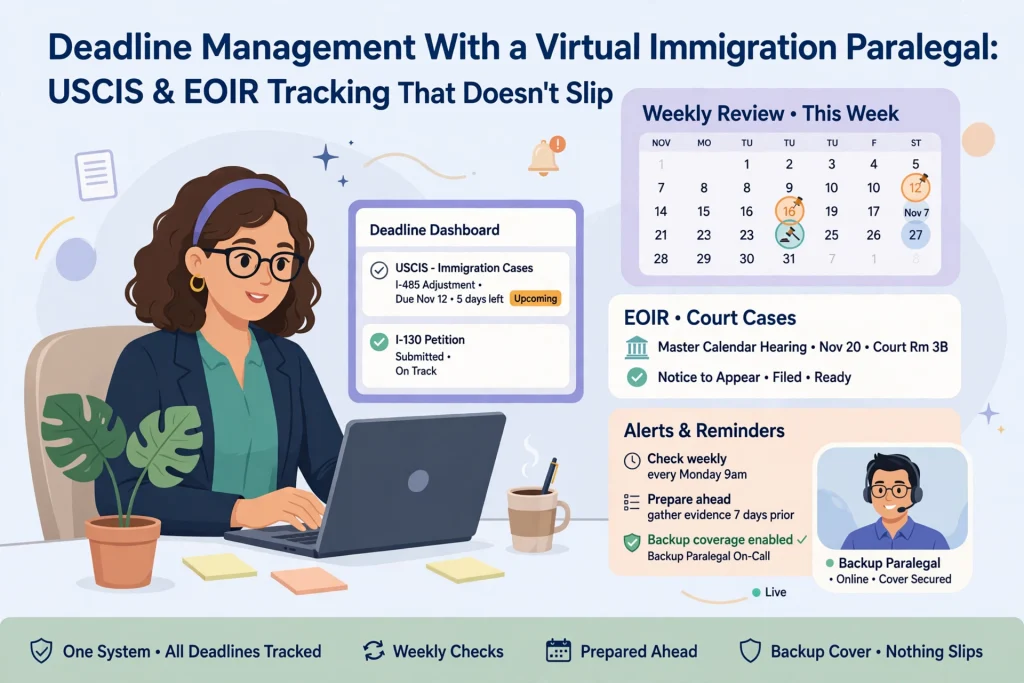
A missed deadline in immigration can end a case. That risk alone is a hiring signal, and it is the sign that should never wait for a second sign to confirm it. The fix is not a better memory or a better spreadsheet. It is a master calendar with a named owner for every date, advance reminders, a daily check for new notices and moved dates, and a named backup who monitors the same calendar when the owner is away. A virtual paralegal can own that calendar as administrative tracking, while the attorney decides on flagged cases. The calendar is the system. The paralegal is the owner. The attorney is the decision maker. When those three roles are clear, a deadline stops living in one head and starts living in a place the whole firm can see.
Ask yourself one test question. If the person who knows the most deadlines left the office today and did not return for two weeks, would every deadline still be found, owned, and reminded on time? If the answer requires a pause, a search, or a phone call, the sign is true.
Sign 3: Documents have slipped, or cases stall in week one
Cases stall in week one for a simple reason. A file opens, the documents needed are listed, and then nothing chases them until the attorney asks. The missing item is often ordinary: a birth certificate, a tax record, or a client questionnaire. The stall is not caused by the document being hard to get. It is caused by no one owning the chase.
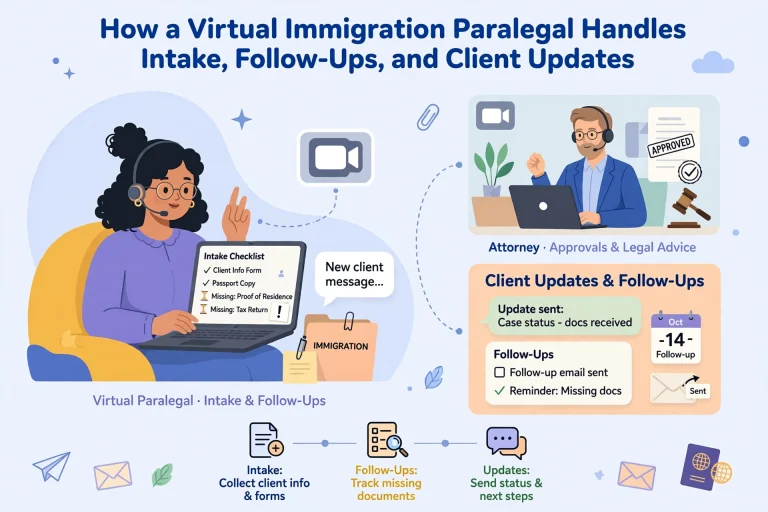
If cases stall waiting for a document, and no one chased it until the attorney asked, intake has no owner. That is the first task to delegate, because intake is where every later delay begins. A file that starts incomplete stays incomplete, and every later step, forms, evidence, filing, inherits the delay. A paralegal who owns intake sends tailored questionnaires, chases missing documents against a per-case checklist, and flags a file as ready or blocked, so the attorney sees status without having to ask for it.
The scene to recognise is the file that looks active but is not moving. The client thinks the firm is working on it. The firm thinks the client is gathering documents. No one has sent the follow-up that would break the standstill. The fix is a named owner, a checklist, and a follow-up rhythm, with the attorney deciding only when a document problem needs a legal decision. For the intake system in full, see How a Virtual Immigration Paralegal Handles Intake, Follow-Ups, and Client Updates.
Sign 4: RFE responses are rushed and incomplete
An RFE response assembled under pressure looks a certain way. Documents arrive late, the packet has no index, an item the officer asked for is missing or assumed, and the attorney reviews a packet that is still being built. The firm does not have an RFE system in that moment. It has an RFE scramble, and a scramble is a sign, not a character flaw.
A trained paralegal owns the checklist, the packet, and the deadline. The RFE is read against a checklist, every document and every point the officer raised is listed separately, evidence is gathered and cross-checked, and the response packet is assembled and indexed for attorney review, with the response deadline tracked from the date on the notice. The attorney owns the legal argument, decides whether the evidence meets the standard, and signs off. That division is what turns a scramble into a system: the paralegal owns assembly and tracking, the attorney owns judgment.
The test for this sign is the last RFE the firm handled. Was the packet indexed before the attorney saw it? Was every requested item accounted for, with nothing assumed? Was the deadline calendared from the notice on the day the notice was seen, with advance reminders before it? If any answer is no, the firm is relying on effort under pressure instead of a system under control. For the RFE process in full, see RFE Support From a Virtual Immigration Paralegal: What Firms Can Delegate.
Sign 5: Clients call for updates the firm should have sent
If clients call asking what happens next, or whether the firm received a document, the firm is not sending status updates. That is not a client problem. It is a communication system problem, and it is paralegal work.
The scene is easy to recognise and easy to misread. A client calls, the attorney stops legal work to answer, the answer is reassuring, and the firm concludes that clients simply like to call. What actually happened is that the client had no recent update to rely on, so the call became the update system. Every such call costs attorney time twice: once to answer, and once to recover the interrupted work. Worse, a client who has to chase the firm for news starts to doubt whether the case is moving, even when it is.
The fix is a status update rhythm owned by someone other than the attorney. After intake, after a filing, after a receipt, after a notice, and at agreed intervals in between, the client receives a short update that says what happened, what happens next, and what, if anything, the client needs to send. The paralegal sends those updates from the case checklist and the master calendar, and routes any legal question to the attorney instead of answering it. Clients stop calling for procedural news when procedural news arrives without being asked for. The attorney’s phone stops being the firm’s update system.
Sign 6: Every new hire restarts immigration training from zero
If every hire means two to four months of the attorney teaching form families, edition dates, and filing cadence, the firm is paying for training again and again. The attorney becomes the training department, the new hire learns slowly because the teacher is also the busiest person in the firm, and the first weeks produce little useful work. Then the hire leaves, or the workload changes, and the cycle starts again.
A paralegal who completes the AILA Paralegals Online Course curriculum arrives with that training already done. That is the precise wording from the live SMY service page, and it matters because it names a curriculum the firm can verify, rather than a vague claim about training. The curriculum covers USCIS filing standards, document requirements, and case management, so week one can be productive work under attorney supervision, not a training project. The attorney still supervises, still reviews, and still signs. What changes is that the attorney stops teaching the same foundations from zero with every hire.
The test for this sign is the last hire. How many attorney hours went to teaching form families, edition dates, and filing cadence before the hire could own a file? If the answer is measured in months, the firm is paying a training tax on every hire, and a pre-trained paralegal removes that tax. Ask any provider to name the training, the topics, and what the paralegal can do in week one because of it. A vague offer says trained assistant. A verifiable offer names the curriculum.
Sign 7: Volume is growing, but headcount cannot
If caseload is rising and a full-time in-house hire does not make sense yet, the firm faces a gap between the work coming in and the staff available to do it. The original draft put the gap in numbers: a full-time in-house hire at about 7,500permonthfullyloaded,and8,000 to 10,000ormorepermonthinNewYorkCity,plus6to10weekstorecruit,againstdedicatedvirtualsupportat2,800 to $4,000 per month. Those figures are carried over from the original draft and are used consistently across the live SMY pages, and they should be re-checked against the current pricing guide before publishing, because prices and terms change. The point of the numbers is not the exact figure. It is the shape of the choice: a large, slow, fixed commitment against a smaller, faster, scalable one.
Dedicated virtual support scales with volume, without office overhead. When volume rises, hours and task scope can expand. When volume falls, the firm is not carrying a full-time salary, benefits, and office cost for work that is not there. That flexibility is the bridge for a firm that is growing but cannot yet justify a full-time hire, or that needs cover for a busy period without committing to headcount. It is not a reason to hire without a defined task set. Volume alone, without an owner and a task set, only spreads the same chaos across more hands.
The test for this sign is the next three months. Is volume rising, flat, or falling? If it is rising, and the attorney is already the bottleneck for admin, waiting for a full-time hire to make sense means paying for the gap in attorney hours and stalled cases in the meantime. See the full comparison in Immigration Paralegal Cost: 2026 Pricing Guide, and confirm current figures there before relying on the ranges in this guide.
How many signs mean hire now?
The original draft’s framework still holds, and it is worth keeping exactly, because it stops a firm from treating every sign as an emergency and from treating an emergency as a watch item.
One sign means watch it, and name the task you would delegate first. Do not hire on one sign alone, but do not ignore it either. Name the task, note the hours it costs, and check again in two weeks.
Two to three signs mean start with a defined task set, intake, forms, or deadline tracking, and review after two weeks. A defined task set is the key phrase. Start with the bottleneck, give it a named owner, agree how success will be measured, and review at the end of two weeks before expanding. That review is where the firm learns whether the bottleneck was the task, the owner, or the volume.
Four or more signs mean the load has already outgrown staffing. Start with a dedicated assistant on your bottleneck, not with a generalist who needs training. A generalist who needs two to four months of attorney teaching will make the next two months worse, not better. A dedicated, pre-trained paralegal on the bottleneck, under attorney supervision, with backup cover, is the start that matches the urgency.
What hiring does not fix
Hiring does not fix a firm that has no defined task set, no supervision rhythm, and no measure of success. It adds a person to an undefined system, and the new person learns the chaos instead of fixing it. Before hiring, the firm needs three things, even in rough form: the bottleneck task, named in one sentence; the supervision rule, that the attorney reviews and signs every filing; and the measure, such as attorney hours saved, documents arriving faster, or updates sent without a client call. Those three things can be written in an afternoon. Without them, the first two weeks of any hire will be spent discovering what the firm actually wanted, and the firm will conclude, wrongly, that the hire did not work.
Hiring also does not remove the attorney from the work. All paralegal tasks are performed under the direct direction and supervision of the licensed attorney of record. Paralegals do not provide legal advice, do not establish attorney-client relationships, and do not represent clients. The attorney decides strategy, approves filings, and decides on flagged cases. What hiring changes is who moves the admin forward, who chases the document, who owns the calendar, and who sends the update. What it must never change is who decides the law.
When to start: before the busy period, not during it
Should a firm hire before or after a busy period? Before. Hiring during a backlog means training under pressure, with the new person learning systems while the docket is at its fullest and the attorney has the least time to teach. Hiring before means cover is in place when volume rises, the task set is agreed while there is still time to agree it, and the first review happens before the pressure peaks. It is the same logic as booking holiday cover before the holidays, not after the owner has already left.
The same timing logic applies to the first two weeks. Start with the bottleneck, review after two weeks, and expand only on evidence: the bottleneck moving faster, attorney hours falling, documents arriving, updates going out. If the evidence is not there, change the task set or the supervision rhythm before adding more tasks. A small, measured start that works is worth more than a large, vague start that cannot be judged.
Frequently asked questions
Is it too early to hire if we are a small firm?
No. Small firms feel admin burden first, because there is no one else to absorb it. A solo attorney is the intake team, the filing team, the deadline calendar, and the client update team, plus the lawyer. Start with a defined task set on the bottleneck, and review after two weeks, rather than waiting until the load forces a rushed hire. For solo practice in full, see Virtual Immigration Paralegal for Solo Practices: How to Get Help Without Hiring Full-Time.
Should I hire before or after a busy period?
Before. Hiring during a backlog means training under pressure. Hiring before means cover is in place when volume rises, the same logic as booking holiday cover before the holidays. Agree the task set and the supervision rhythm before the busy period, and review after the first two weeks.
What is the first task to delegate?
The bottleneck: whichever of the seven signs is costing the most attorney hours right now. Start there, name the owner, agree how success will be measured, review after two weeks, then expand. Do not start with everything at once.
Do I need a full-time hire, or can I start small?
Start small, with a defined task set. A full-time hire is a large, fixed commitment, and it only makes sense when volume and task scope are already clear. A defined task set on the bottleneck, reviewed after two weeks, tells the firm whether to expand, and by how much, on evidence rather than on a guess.
What stays with the attorney when a virtual paralegal helps?
Legal judgment, strategy, approval, and sign-off. All paralegal tasks are performed under the direct direction and supervision of the licensed attorney of record. The paralegal owns the how and the when: intake chasing, form drafting, evidence assembly, deadline tracking, and status updates. The attorney owns the what and the why: what the filing argues, whether the evidence meets the standard, and whether the filing goes out.
The bottom line: if attorneys do admin, deadlines live in memory, or training restarts with every hire, you are already paying for support, in attorney hours, missed dates, and stalled cases. The question is not whether to hire, but what to delegate first. Count your signs, name the bottleneck, start with a defined task set, and review after two weeks.
See how support fits your docket on our Immigration Paralegals page, or book a free session with SMY Solutions, Brooklyn, NY, (929) 327-5878, and bring your signs. We will map the first tasks to delegate for your firm.

Comments (0)
No comments yet. Be the first to share your thoughts.