
RFE Support From a Virtual Immigration Paralegal: What Firms Can Delegate

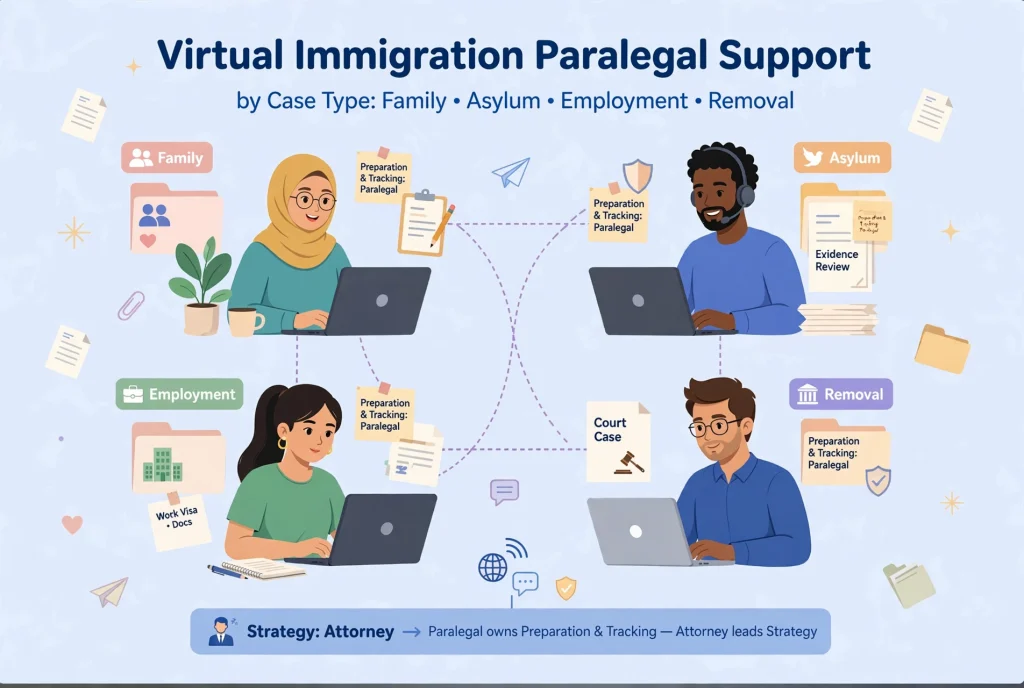
A virtual immigration paralegal can delegate RFE support by reading the request against a checklist, gathering and organising the requested evidence, assembling and indexing the response packet for attorney review, and tracking the response deadline. The attorney owns the legal argument; the paralegal owns the assembly.
An RFE is not a denial. It is a request for more evidence — and a second chance with a deadline. The costly mistake is a rushed, incomplete response.
Step 1: Read the RFE against a checklist
The paralegal’s first job is to turn the RFE into a checklist: every document, every piece of evidence, every point the officer raised, listed separately. No item is assumed, no item is grouped vaguely as “more evidence.” If the RFE asks for five things, the checklist has five lines.
Step 2: Gather and cross-check the evidence
For each checklist item, the paralegal pulls the document, checks it is current and complete, and cross-checks it against the claim it supports. A clean packet is easier to adjudicate — and harder to deny on a technicality. Missing items are flagged to the attorney and the client immediately, not discovered the week the response is due.
Step 3: Assemble and index the response
A strong RFE response packet has four qualities:
• Complete — nothing the officer asked for is missing or assumed.
• Indexed — the officer can follow the logic without hunting, with a cover letter and exhibit index.
• Current — forms are the right edition, fees are right, dates are right.
• Clear — the cover logic says, in plain order, why the evidence meets the standard.
The paralegal drafts the cover letter and exhibit index for attorney review. The attorney approves the legal logic and signs off. That division is what makes the response both fast and safe.
Step 4: Track the deadline — and the filing
RFE deadlines do not forgive a missed calendar entry. The paralegal logs the response window, sets advance reminders, and tracks the filing itself — receipt, confirmation, and case-status updates after submission. If a notice never arrives or a case stalls beyond normal processing times, that is flagged early, not discovered months later.
What stays with the attorney?
Paralegal owns | Attorney owns
Checklist, gathering, assembly, index | Legal argument and strategy
Deadline tracking and filing logistics | Whether the evidence meets the standard
Client document chasing | Final review and sign-off
Frequently asked questions
Does an RFE mean the case will be denied?
No. An RFE means the officer needs more evidence to approve the case. A complete, indexed response can still win it. A rushed, incomplete response is what turns an RFE into a problem.
How fast should an RFE response be assembled?
As fast as completeness allows — start the checklist the day the RFE arrives, not the week it is due. Early assembly leaves time for attorney review and for chasing any document that is missing.
What training should RFE support have?
Immigration-specific training on evidence-packet standards and RFE patterns. SMY paralegals are AILA-trained — trained through American Immigration Lawyers Association (AILA) programs and resources — so they arrive knowing what a complete packet looks like, not learning it on your RFE.
The bottom line: RFE support is assembly work with a deadline, and it is exactly the work a trained virtual paralegal should own — checklist, evidence, index, and tracking — while the attorney owns the argument.
See the full task list in What Does an Immigration Paralegal Do?, or book a free session to map RFE support to your caseload. SMY Solutions, Brooklyn, NY, (929) 327-5878.


Comments (0)
No comments yet. Be the first to share your thoughts.