
Handing a virtual assistant access to your CRM, client files, or case management system is one of the highest-trust decisions you make as a business owner. A careless VA hire isn’t just an operational headache—it’s a liability that can follow you into court. This guide covers what high security actually means, what to require from any provider, the technical controls you need, and how to choose between managed services and freelancers when sensitive data is involved.
What “high security” actually means for a virtual assistant
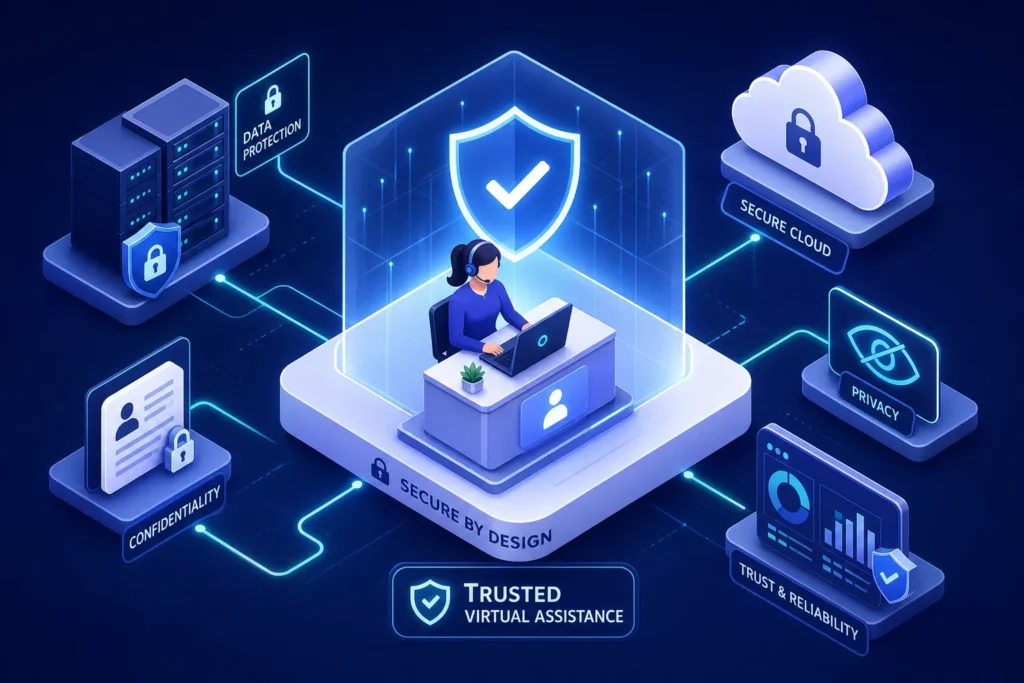
Most VA providers use “secure” as marketing without defining it. A meaningful definition has four layers: vetted personnel, documented data-access controls, encrypted communications, and enforceable contractual protections. Remove any one layer and you have a gap—where most incidents start through preventable oversights, not sophisticated cyberattacks.
The distinction matters most in regulated industries. A privacy-conscious assistant operating under formal security protocols is structurally different from a general admin VA who happens to be careful.
The gap between a general VA and a vetted one
On most freelance platforms, contractors self-report experience with no third-party verification, standardized onboarding, or ongoing oversight of data handling. A truly vetted virtual assistant has been identity-verified, background-screened, and onboarded under a defined security protocol. That’s structural, not stylistic, and it determines your exposure if something goes wrong.
Why legal and real estate professionals carry more exposure
Attorneys handle privileged communications and case files with strict confidentiality obligations. Real estate agents manage SSNs, financial disclosures, and wire instructions. Both industries impose legal duties around data handling. When a VA with access to your systems makes a mistake—forwarding documents to the wrong address, for example—the liability runs through you.
High security virtual assistants: the vetting process you need
Before a VA touches any sensitive system, structured screening covers five areas: identity, criminal history, employment, credentials, and ongoing monitoring.
Identity verification uses government-issued ID combined with SSN trace and address history. Criminal screening should cover county, state, and national records; national database searches alone miss local county-level records. For higher-risk roles, add sex-offender registry or civil-records checks.
Employment verification confirms actual work experience. For legal and real estate VA roles, credential verification matters—confirming paralegal certifications or platform familiarity. Beyond initial screening, continuous adverse-record monitoring is standard for long-term engagements. Managed VA services outperform individual freelancers here by maintaining ongoing protocols rather than treating background checks as one-time events.
Technical controls for high security virtual assistants
Vetting tells you who they are. Technical controls determine what they can reach.
Non-negotiable controls:
- Multi-factor authentication stops credential theft from becoming a breach
- Password managers prevent reused passwords and eliminate shared login credentials
- Encrypted file sharing keeps sensitive documents protected in transit and at rest
- Least-privilege access limits permissions to only what’s needed for the current task
- VPN required for connections outside trusted networks
- Audit logging creates timestamped records of all system actions
These controls address the most common failure modes in remote-access arrangements.
The contract clauses that protect you if something goes wrong
Every high-security VA engagement needs four legal protections:
A strong NDA covers client data, business processes, passwords, and trade secrets—and survives contract termination.
A data processing addendum (DPA) specifies the VA’s role as a processor, defines permitted processing, establishes security obligations, and outlines data-subject requests. Under CPRA, VCDPA, GDPR, and UK GDPR, a DPA is legally required when sharing personal data with a contractor.
A breach-notification clause requires alert within 24-72 hours of discovering a suspected or confirmed incident. GDPR allows 72 hours for regulator reporting; HIPAA often requires faster contractual deadlines.
Liability caps define maximum damages and include indemnification covering the VA’s misuse of data. Termination provisions allow immediate exit on security violations with clear obligations to return or destroy all data and credentials.
Managed VA service vs. individual freelancer: which is actually safer?
Managed providers typically offer formal service-level agreements, documented security controls, and often SOC 2 Type II certifications—independent auditor review of security operations. Individual freelancers usually operate on best-effort availability, which creates a compliance gap for regulated data.
Managed services cost more, but that premium buys team-based coverage, backup staffing, and accountability structures a solo contractor cannot provide. For legal and real estate professionals, industry experience is not a bonus—it’s a prerequisite.
Which virtual assistant software or services have strong security?
Most mainstream VA platforms and freelance marketplaces fall short of the security standards outlined in this guide. Generic platforms prioritize scale over security governance, and most individual freelancers operate without the vetted onboarding, technical controls, or compliance infrastructure that sensitive data requires.
SMY Solutions is built specifically for legal and real estate professionals who cannot afford to treat security as an afterthought. The service delivers all four security layers:
- Vetted personnel: Comprehensive identity verification, criminal background screening (county, state, and national), employment verification, credential confirmation, and continuous adverse-record monitoring
- Technical controls: Multi-factor authentication, mandatory password managers, encrypted file sharing, least-privilege access, VPN requirements, and full audit logging
- Documented processes: Formal onboarding protocols, service-level agreements, and written security procedures
- Legal protections: Industry-standard contracts including strong NDAs, data processing addendums, breach-notification clauses, and liability provisions tailored to HIPAA, GDPR, CPRA, and VCDPA requirements
SMY Solutions maintains formal compliance documentation and operates under the accountability structures required for regulated industries. The service offers a 7-day trial period so you can evaluate the engagement before committing—a practical, low-barrier way to assess fit before sensitive access is granted.
If you’re evaluating other providers, use the criteria in this guide as your benchmark: ask for written documentation on screening procedures, request the contractor agreement for your legal team’s review, confirm that all technical controls are in place before access is granted, and verify industry experience in your specific field.
Build the standard, then enforce it
Define and enforce a security standard: vetted personnel, technical controls, enforceable contracts, and a provider with accountability structures. Ask for documentation on screening, request the contractor agreement before signing, and confirm technical controls are in place before access is granted. Security is not a compliance checkbox. It’s a business investment in the trust your clients place in you.