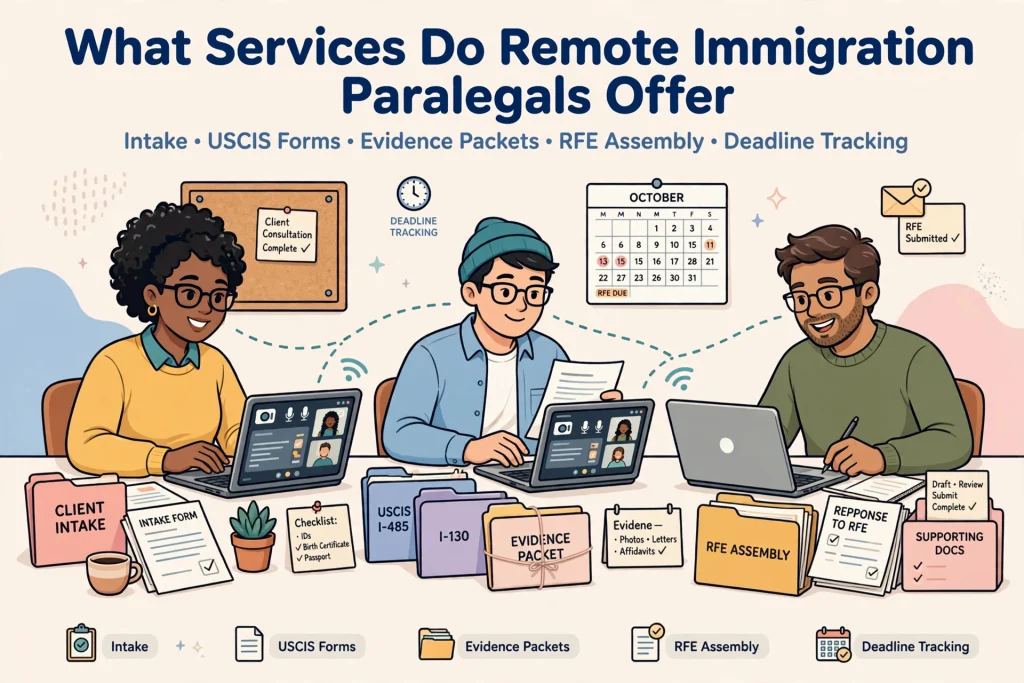
Remote immigration paralegals offer intake and document collection, USCIS form preparation, evidence-packet assembly, RFE response support, and deadline and case-status tracking — all under attorney supervision. They do not give legal advice, set strategy, sign filings, or represent clients.
If you are trying to map a service offer to your caseload, this is the menu, by workflow, with the attorney/paralegal line for each service.
1. Intake and client communication
- Intake questionnaires drafted, sent, and reviewed so the facts the attorney needs arrive the first time: travel history, entries and exits, prior filings, family relationships.
- Document collection and chasing — requesting, logging, and following up on passports, birth and marriage certificates, tax records, pay stubs, and police clearances, with a per-case checklist.
- Client status updates — confirming receipt of documents, explaining what happens next in plain language, and answering procedural questions, so clients stop calling the attorney for news.
- Biometrics and appointment scheduling — ASC appointments, interview notices, reschedules, and preparation checklists for what clients need to bring.
2. USCIS forms and filings
- Form preparation for the forms at the heart of immigration practice: I-130 petitions, I-485 adjustment applications, N-400 naturalization applications, I-765 work authorization requests, and others, by transferring verified intake data accurately and consistently across related filings.
- Edition-date and fee verification — checking every form is the current USCIS edition before filing (an outdated edition means automatic rejection) and calculating correct filing fees.
- Filing packages — assembling the complete package for attorney review, so the attorney checks finished work instead of building it.
3. Evidence and case building
- Supporting-evidence packets — organising documents in the order adjudicators expect, tabbing and labelling exhibits, and cross-checking that every claim has supporting proof behind it.
- RFE response assembly — pulling requested documents, organising the response package, drafting the cover letter and exhibit index for attorney review, and tracking the response deadline.
- Country-condition research support — gathering news reports, human-rights documentation, and country-condition summaries for asylum and relief cases, organised into usable research files. The paralegal does the legwork; the attorney decides how it fits the legal argument.
4. Docket, deadline, and case-status control
- Priority-date tracking — monitoring Visa Bulletin movement so the firm knows the moment a case becomes current.
- Receipt-number monitoring and case-status checks — logging USCIS receipt numbers, running regular status checks, and flagging anything unusual: a case stuck beyond normal processing times, a notice that never arrived, a transfer to another service centre.
- Hearing-date and deadline calendars — a master calendar of EOIR hearing dates, USCIS deadlines, RFE response windows, and filing cutoffs, with advance reminders, not day-of surprises.
The full 12-task list is in What Does an Immigration Paralegal Do?
What stays with the attorney?
| Paralegal owns | Attorney owns |
|---|---|
| How forms get completed | What relief to seek |
| When deadlines hit | Why an argument works |
| How evidence is organised | Whether a filing is legally sound |
| Client updates on procedure | Legal advice and strategy |
| Tracking and follow-ups | Signing filings and representation |
This division is what makes delegation safe. A trained paralegal recognises a legal question and routes it to the attorney, rather than answering it.
How do firms usually start?
Most firms start with one workflow — usually intake and document chasing, or form preparation — and expand after a review. That is the fastest way to see whether the model fits, without handing over a whole docket on day one. The step-by-step first-30-days plan is in How to Hire a Virtual Immigration Paralegal: The First 30 Days.
Frequently asked questions
Do remote paralegals handle EOIR cases as well as USCIS?
Yes, for administrative support: hearing calendars, filing deadlines, and document preparation for attorney review. Representation before EOIR stays with the attorney.
Can a remote paralegal communicate directly with my clients?
Yes, for administrative matters: scheduling, document requests, status updates, and procedural explanations. Anything touching legal advice or strategy goes to the attorney.
What training should a remote immigration paralegal have?
Immigration-specific training, verifiable by name. SMY Solutions paralegals are AILA-trained — trained through American Immigration Lawyers Association (AILA) programs and resources — so they arrive knowing form families, edition dates, and evidence standards.
The bottom line: remote immigration paralegal services cover the full administrative lifecycle of a case — intake, forms, evidence, and deadlines — while strategy, legal advice, and signing stay with the attorney.
See how it works for your caseload on our Paralegal Assistants service page, or book a free session. SMY Solutions, Brooklyn, NY, (929) 327-5878.